Today I Learned
Harie Kabata: The Shiga Village Where Carp Share the Kitchen
How Harie's spring-fed kabata work, what the carp actually do, and how to book a local guided visit—including English booking deadlines and 2027 fees.
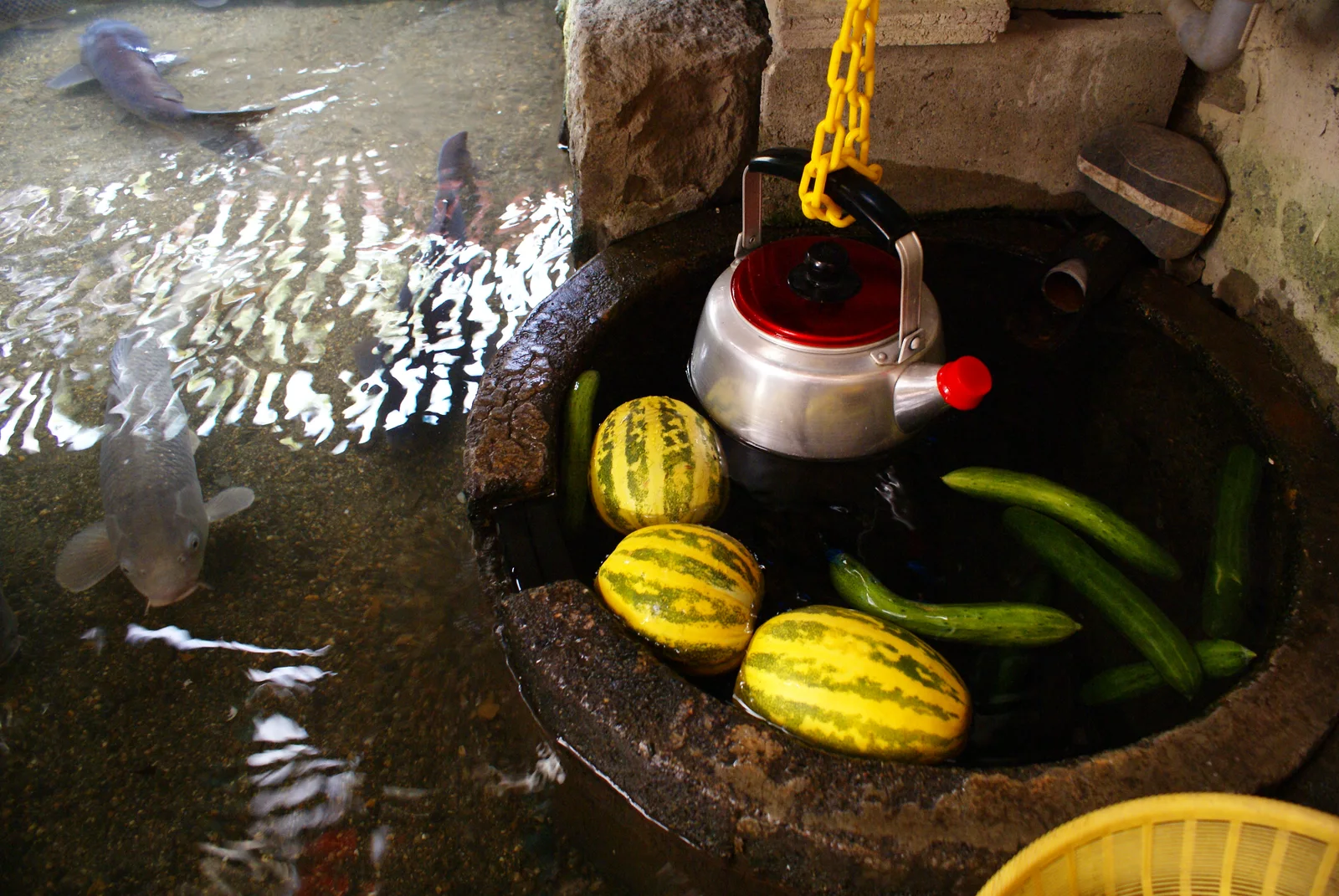
In Harie, Shiga, carp have a job in the household water system: eating food scraps in a lower pool before the water continues towards the village streams and Lake Biwa. They are part of a kabata—a working arrangement of spring water and basins used in everyday life. Takashima City’s explanation
The fish are a memorable detail, but follow the water upstream and the kitchen becomes more interesting. There is a source, a sequence of different uses, and a household deciding how to look after it.
Research note: This article uses official community and tourism information checked on September 26, 2026. We have not visited in person.
Photo: wakamoana, August 2008, via Wikimedia Commons, CC BY-SA 3.0. Resized and converted to WebP under the same licence. This historical photograph does not identify a guaranteed stop on current tours.

Why the water comes into the house
Harie is a settlement in Takashima, on the western side of Lake Biwa. Rain and snow from the Hira mountains feed the groundwater that emerges here. Residents call this spring water shozu. The local committee describes water rising through pipes driven roughly 10–20 metres underground, supplying households throughout the year. The community’s account
A kabata puts that water to work close to home. People have used it for drinking and cooking, washing vegetables and keeping summer produce cool. The committee describes cucumbers, tomatoes and watermelons sitting in the basin: cooling food is another everyday use of the flowing water. How residents use their kabata
That gives you something specific to look for during a visit. Where does fresh water emerge? Where are vegetables placed? Which basin holds the fish? Those details explain more than a photograph of a clear stream alone.
Follow the water, then look for the carp
Takashima City’s description follows three stages:
- Motoike: the point where the spring water emerges.
- Tsuboike: the basin receiving that water for household tasks.
- Hataike: the downstream pool where carp eat scraps from food preparation, before the water leaves for the watercourse outside.
The sequence matters. The carp are downstream of the household uses in this description. It does not mean fish make drinking water safe or replace washing dishes. Their role is eating scraps within a larger system of water use. The city’s description of the flow
Visit with someone who lives here
Kabata are on private property and remain places of family life. The Harie Shouzu no Sato Committee arranges visits with local resident guides, entering only where householders have agreed. Book a tour to see these spaces; a village walk does not give permission to enter them. Official visitor arrangements
A good question for your guide is how the household uses its kabata today. Ask before photographing people or domestic spaces, and let the host show you where to stand. This is an opportunity to understand someone’s kitchen, with its owner still very much part of the story.
Booking, times and fees
The usual tours start at 10:00 or 14:00 and take approximately one hour. Mondays are closed, with additional unavailable dates. Start with the official tour page, which links to the current closure notice and application forms. Bring cash; cards and electronic payments are not accepted.
| Visitor | Current fee | From January 5, 2027 |
|---|---|---|
| Adult, excluding eligible high-school students | ¥1,000 | ¥1,500 |
| Elementary, junior-high and high-school students up to age 18 | ¥500 | ¥500 |
The increase applies to the tour date, not the date you book. The committee says these fees support its operations, safety measures and local environmental conservation. Dated fee-change notice
For English guidance, apply at least one month ahead. The current English application explicitly requests this lead time. Japanese-language guidance gives one week; English-speaking guide availability is more limited. The committee says nearer dates can sometimes work, but wait for its confirmation before treating a request as a booking. Booking guidance
Getting to Harie
The nearest railway station is Shin-Asahi on the JR Kosei Line. Shiga’s tourism bureau gives a walk of approximately 15 minutes from the station. Check your train connection against the confirmed tour time and leave room to reach reception before it begins. Official tourism access details
Continuing to Osaka afterwards? Mitsutera’s wooden temple hall beneath a modern hotel is another place where a surprising building arrangement still serves daily life.