Today I Learned
Why Ise Jingu Is Rebuilt Every 20 Years
Explore Ise Jingu's 20-year rebuilding tradition, what visitors can see, the current cycle, shrine hours and Sengukan museum fees in Ise, Mie.
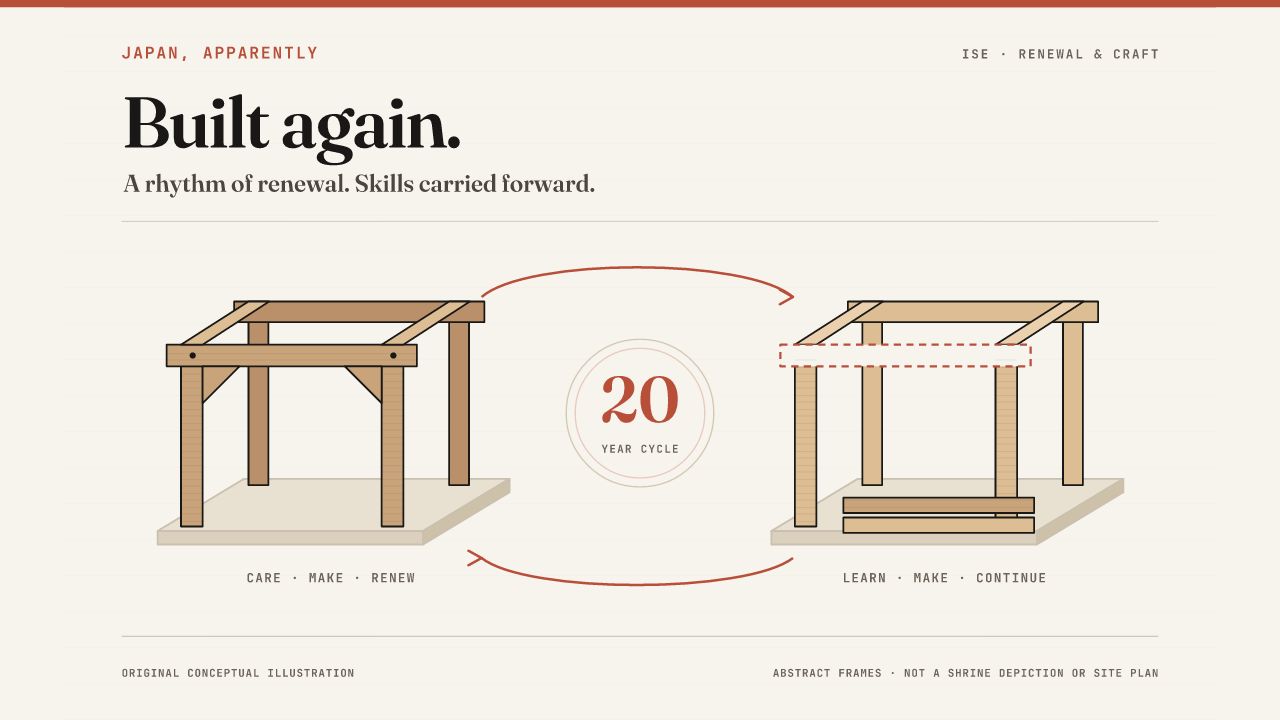
Ise Jingu’s main sanctuaries are rebuilt on adjoining sites as part of a 20-year ritual called Shikinen Sengu. New buildings and sacred furnishings are prepared, then the kami are ceremonially transferred. The practice preserves architectural forms and the skills needed to make them again. For a visitor to Ise in Mie Prefecture, the story begins with the ground beside a sanctuary. Jingu’s explanation of the ritual
Apparently, one way to keep a building tradition alive is to keep building.
Research note: We checked the official sources on October 16, 2026. We have not visited, entered a construction area or attended a Sengu ceremony.
Why rebuild instead of keeping the same wood?
Jingu describes renewal as a way to pass on shinmei-zukuri architecture, craft techniques and the making of sacred apparel and treasures. Its sacred buildings continue in a recognisable form while craftspeople produce the next generation of them. Jingu’s account of Sengu’s meaning
Why exactly twenty years? The shrine says early texts prescribe the interval without explaining its reason. Various explanations have been proposed; training the next generation is an important result of the practice, rather than a documented single answer to the original choice of twenty. What the shrine says about the interval
Jingu’s English publication also explains that much of the dismantled timber is reused at other shrines. The transfer preserves more than a shape: it keeps materials, methods and people in a continuing relationship. Jingu’s Soul of Japan publication
A long tradition with a current timetable
The first Sengu at Naiku, the Inner Shrine, was held in 690. The 62nd took place in 2013. Jingu’s historical account also records interruptions, including a long break in the late medieval period. Treat the twenty-year cycle as the tradition’s intended rhythm, rather than an unbroken mathematical sequence since 690. Official history
As checked in October 2026, the official 63rd Sengu schedule runs from preparations in 2025 toward the central transfer in 2033, with further shrine transfers in 2034. The schedule is presented as planned arrangements based on the previous cycle. A date on it does not establish public admission to that ceremony. Current planned schedule
You do not need to wait for the transfer year to understand the idea. The alternate site, called kodenchi, is part of the shrine’s explanation: it is where a previous sanctuary stood and a future one will be built. Kodenchi and the shrine layout
What can an ordinary visitor see?
Ise Jingu includes many shrines, centred on Naiku and Geku, the Outer Shrine. Their sacred palace courtyards are closed to ordinary visitors; worship takes place outside the inner enclosure. A normal visit is not an interior tour of the main sanctuary. Use the public paths, respect barriers and consult the precinct maps. Official introduction and access limits
For a closer architectural view, the Sengukan museum at Geku has a full-scale reconstruction of roughly the eastern quarter of Geku’s main sanctuary. It reproduces the gable end, giving you a close view of its materials and construction. This exhibit helps explain the architecture while the working shrine’s access limits remain in place. Museum’s explanation of the reconstruction
| Sengukan detail | Operator information checked October 16, 2026 |
|---|---|
| Admission | ¥300 general; ¥100 for elementary/junior-high pupils; preschool children free with a guardian |
| Entry hours | 9:00–16:00; viewing until 16:30 |
| Normal closure | Second and fourth Tuesday each month; the following day if that Tuesday is a holiday |
| Reservations | Ordinary admission is not reservation-based; tour groups should notify the museum |
| Photography | No photography inside; media/research photography requires an application |
Temporary closures and changes are possible. The operator lists an English audio guide among its languages: overseas visitors can borrow the device free with a ¥1,000 refundable deposit. Check availability at reception; this is separate from a guaranteed English-speaking tour. Museum’s visitor guide and conditions
Plan Geku and Naiku as two separate stops
Ordinary shrine admission is free; the museum fee above is separate. Ise City Tourism Association’s FAQ
Geku is about a five-minute walk from Iseshi Station’s JR-side exit. To continue to Naiku, choose a current bus or taxi route rather than assuming the two main shrines share one entrance. The shrine’s English access page links the Geku–Naiku bus routes and gives the two distinct addresses. City’s access guide · Jingu’s official access page
| Shrine visiting season | Normal hours |
|---|---|
| January–April and September | 5:00–18:00 |
| May–August | 5:00–19:00 |
| October–December | 5:00–17:00 |
New Year arrangements can differ. In October, plan to finish by 17:00, and check the official notices for your date. These shrine hours do not apply to Sengukan. Current shrine hours
Jingu describes visiting Geku before Naiku as a longstanding custom, not a compulsory order. The walking time and transport between them need their own allowance. Official visiting FAQ
Keep the camera and the visit within the rules
Check posted photography signs and the official map. Jingu prohibits photography in designated places, drones, ladders, livestreaming and commercial photography, including publication that earns revenue. Media photography requires advance permission from the administration. A place where you can stand is not automatically a place where you can photograph or publish commercially. Current photography rules
Ceremonies can temporarily restrict parts of the paths. Keep to the public route rather than using the rebuilding project as a reason to seek a construction viewpoint. We have not verified a complete step-free itinerary, a public construction tour or travel-date access to a particular rite.
For another connection between craft and continuity, read about Kongo Gumi’s temple-building history. In Osaka, Mitsutera’s wooden hall was preserved beneath a new hotel. More places and their background are gathered in Curious Japan.
Original conceptual illustration of rebuilding and craft continuity. It is not a photograph, a shrine plan or a depiction of Ise Jingu’s actual sanctuaries.