Today I Learned
Chinsekikan: Chichibu's Museum of Stones That Look Like Faces
Explore Chinsekikan, Chichibu's private museum of face-like stones: the idea behind the collection, admission and what to confirm before visiting.
Chinsekikan in Chichibu, Saitama, is a private museum with a collection of stones that look like faces. The Japanese term jinmenseki (人面石) literally means human-faced stones. The museum’s official account introduces individual examples, including a favourite of the second director. The attraction is the moment a collection of marks begins to look like someone looking back at you. The museum’s official account · An individual stone introduced by the museum
Apparently, a stone collection can also be an invitation to notice how you see.
Research note: We checked the operator’s public visitor information on October 20, 2026, then added the broadcaster’s historical account and railway information on October 21. We have not visited or confirmed a booking, photography permission or a travel-date opening.
How a private collection became a museum
Chinsekikan’s background appears in a November 5, 2014 radio appearance by the museum’s director on Bunka Hoso. The broadcaster’s written account describes her father, the museum’s first director, collecting ornamental stones and opening Chinsekikan. It also relates a dream as part of the story behind his growing interest in human-faced stones. That is the family story recorded by the broadcaster, rather than a geological explanation. The programme’s November 2014 archive, November 5 entry
The same account describes visitors giving some of the stones names. The host tried it with examples brought to the studio. It is a helpful way to understand the collection: recognising a face can become an act of interpretation, with the name offering someone else’s reading of the object. We have not confirmed that naming a stone is an activity offered to every visitor today.
The 2014 report gives collection totals, but those are historical numbers. We have not verified a current count and do not use them as a promise about what is on display now.
Why do stones look like faces?
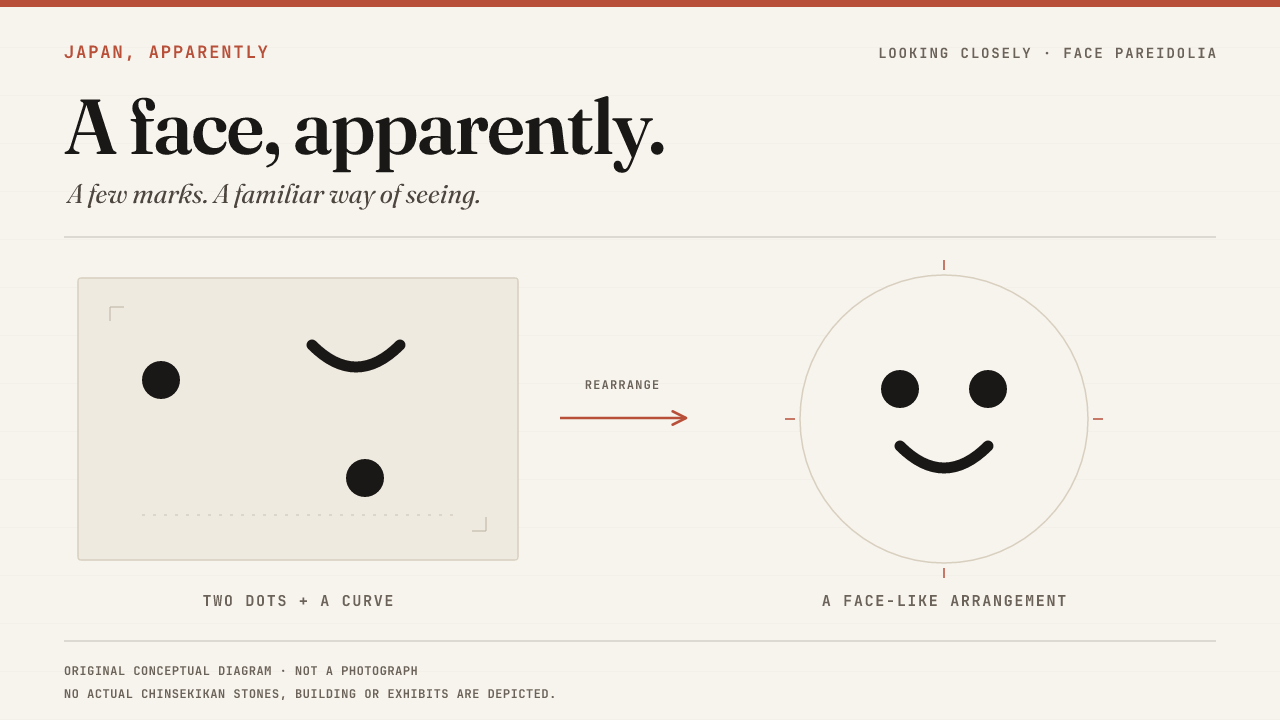
Seeing a face in something that is not a face is called face pareidolia. University of Sydney researchers explain that a rough arrangement of features can trigger face perception even when we know we are looking at an object. Their research also examined how people read emotional expression in such objects. This is general research about perception; it did not test Chinsekikan’s collection. The researchers’ explanation
That gives you a simple looking exercise. Before reading a label, decide where you see the eyes and mouth. Then ask whether the face seems cheerful, stern or surprised, and which feature gives that impression. Compare your interpretation with a companion’s. This is our suggested way to look, not a museum-led activity or a claim that everyone will see the same face.
The point does not depend on agreeing about a famous likeness. A small shift in attention can be the interesting part.
Admission, hours and the call before the trip
The operator’s profile and pinned admission notice gave the following information when checked on October 20, 2026:
| Detail | Operator’s published information |
|---|---|
| Regular opening hours | 10:00–17:00 |
| Regular closing day | Tuesday |
| Junior-high-school age and older | ¥500 |
| Elementary-school children | ¥200 |
| Preschool children | Free |
Sources: official profile and pinned admission notice dated July 2, 2023. The same fee change appears on the operator’s blog. Older pages quoting ¥400 for adults predate that change.
Contact the museum before building a journey around it. Its own introduction warns that temporary closures occur and directs enquiries to 0494-24-7288. The operator says newer updates are posted on its official Instagram. Regular hours are not confirmation that the door will be open on a particular date. Operator’s introduction
We have not established a public rule that makes every visit reservation-only, nor confirmed that an unannounced visit will always be accepted. When contacting the museum, check your date and time, whether an appointment is needed and how to enter. English-language assistance and payment methods have not been confirmed.
Getting to the right address
The museum lists 764-6 Kamikagemori, Chichibu, Saitama. Keep the Japanese address, 埼玉県秩父市上影森764-6, available when planning the final part of the journey. Operator’s address and telephone
For local rail planning, Kagemori Station (影森駅) is on the Chichibu Railway in the same Kamikagemori area. Its official station page links to the timetable. Check the museum’s address and your onward route separately: we have not verified a timed walk from the station to its entrance or a return-train itinerary for your date.
Do not assume that reaching the station establishes an accessible visit. The museum’s 2021 introduction describes the main exhibition room as upstairs, with stairs and no wheelchair ramp. Ask about the present arrangement if steps affect your plans. We have not confirmed subsequent alterations or a continuous step-free route. The operator’s dated access information
Photography and respectful looking
We have not confirmed the current photography, video or publication rules. The museum posting its own photographs does not establish permission for a visitor to photograph everything, touch objects or publish images commercially. Ask staff and follow any signs before doing so.
Treat the stones as someone’s collection. Ask before handling anything, and let the objects and their labels set the pace. A photograph is optional; the face you notice first may be the detail you remember.
If small, specialised collections appeal, our Meguro Parasitological Museum guide introduces another museum built around an individual’s collecting and scientific work. For a very different use of sand, Nima Sand Museum’s one-year hourglass offers another story about looking closely at an ordinary material. These are separate destinations, not a suggested local walking route from Chinsekikan.
Original editorial concept illustration: shapes arranged to suggest faces. This is not a photograph or a depiction of Chinsekikan’s collection, exhibits or building.