Today I Learned
Kanmon Pedestrian Tunnel: Walk from Honshu to Kyushu
Walk beneath the Kanmon Strait in 15 minutes: where to find the pedestrian lifts, the underwater prefectural border, opening hours and a ferry return option.
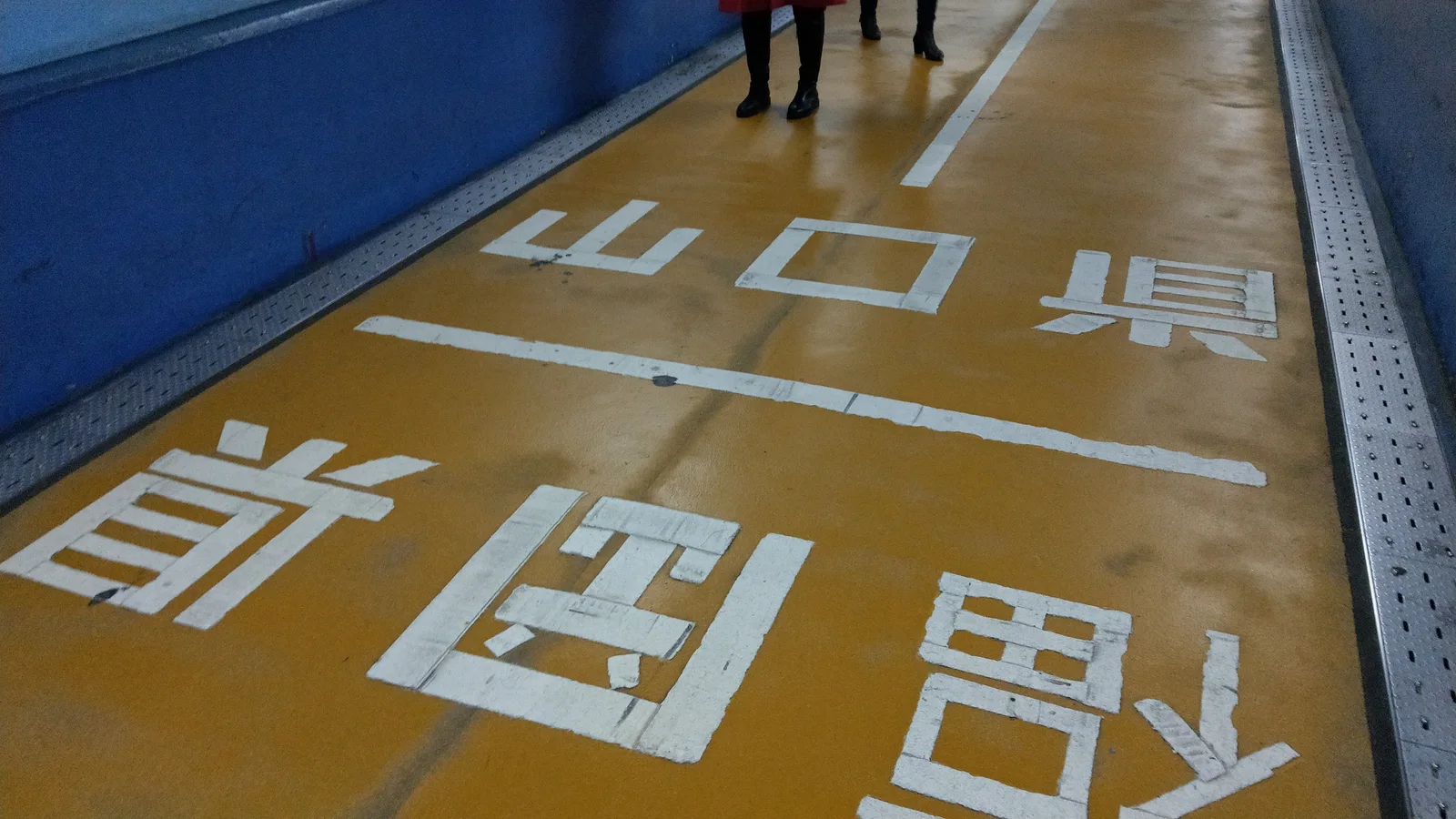
There is a prefectural border painted on the floor beneath the Kanmon Strait. Step across it and you move between Yamaguchi on Honshu and Fukuoka on Kyushu, with the sea overhead. The Kanmon pedestrian tunnel makes that crossing possible without a boat or a train. Fukuoka’s official guide
The appealing part is how ordinary the action is: take a lift, walk down a corridor, and emerge on a different island. The setting does most of the work.
Research note: We checked official tourism, transport and government sources on September 26, 2026. We have not walked the tunnel in person.
Photo: Tzuhsun Hsu, February 2019, via Wikimedia Commons, CC BY-SA 2.0. Resized and converted to WebP under the same licence.

A road upstairs, a footpath downstairs
The Kanmon road tunnel opened on March 9, 1958. It has two levels: traffic uses the upper part, while pedestrians walk below. The shafts at either end bring walkers down from the surface—about 55 metres on the Shimonoseki side and 60 metres on the Moji side. MLIT’s historical account
Think of it as a piece of transport infrastructure you can enter at walking speed. There are no sea views from inside; save those for the waterfront. The interest underground is the geographical fact of where you are, made unusually tangible by that line on the floor.
At the border, a photograph with one foot on each side is an obvious temptation. Leave room for other people to pass, take your picture and move on. MLIT notes that the covered route is also used for everyday walking and jogging, sheltered from wind and rain. Walkway background
How much time and money to allow
| Detail | Published arrangement |
|---|---|
| Pedestrian crossing | 780 metres |
| Walking time | Approximately 15 minutes one way |
| Opening hours | 06:00–22:00 |
| On foot | Free |
| Bicycle or moped | ¥20; push it through |
These details come from the local tourism council’s Moji entrance guide. The walking estimate covers the crossing, not your whole outing. Add time for reaching the entrance, using the lifts and continuing from the other side. Check current notices before relying on a late-evening crossing.
Walking both ways means retracing the same corridor. If you only want the novelty of crossing beneath the strait, one direction gives you that experience; a different return route can make the day more varied.
Find the pedestrian entrance
Search specifically for Kanmon Pedestrian Tunnel, or 関門トンネル人道. The road entrance is not a walking route.
On the Moji side, use the entrance near Mekari Shrine; the local bus stop is Kanmon Tunnel Jindoguchi. On the Shimonoseki side, the entrance is at 22 Mimosusogawacho, beside the Mimosusogawa bus stop. Both pedestrian entrances have lifts. Official access information
Choose your starting side based on the rest of your day. You do not need to cross in both directions simply to reach the border marker. If your group needs step-free travel, check the complete route to the entrance as well as lift availability: a lift inside a facility does not establish accessibility for every connecting bus or pavement.
Return above the water
For a small circuit, combine the tunnel with the Karato–Mojiko ferry. The operator gives a crossing time of approximately five minutes. Check its current timetable, fares and service notices before choosing your return. Kanmon Kisen route information
The ferry terminals and tunnel entrances are different places. Plan the waterfront sections between them on foot or by local transport; do not expect to step out of the tunnel directly onto a boat. It is the contrast that makes this route appealing: underground you know the sea is there, and on the return you can actually see it.
For another Japanese structure whose everyday purpose is more interesting than its nickname, read about G-Cans, the enormous flood-control chamber nicknamed an underground temple.