Today I Learned
Oya History Museum: Utsunomiya's Underground Stone Quarry
Visit Oya History Museum's huge former stone quarry in Utsunomiya: mining history, admission, bus access, cold conditions and photography rules.
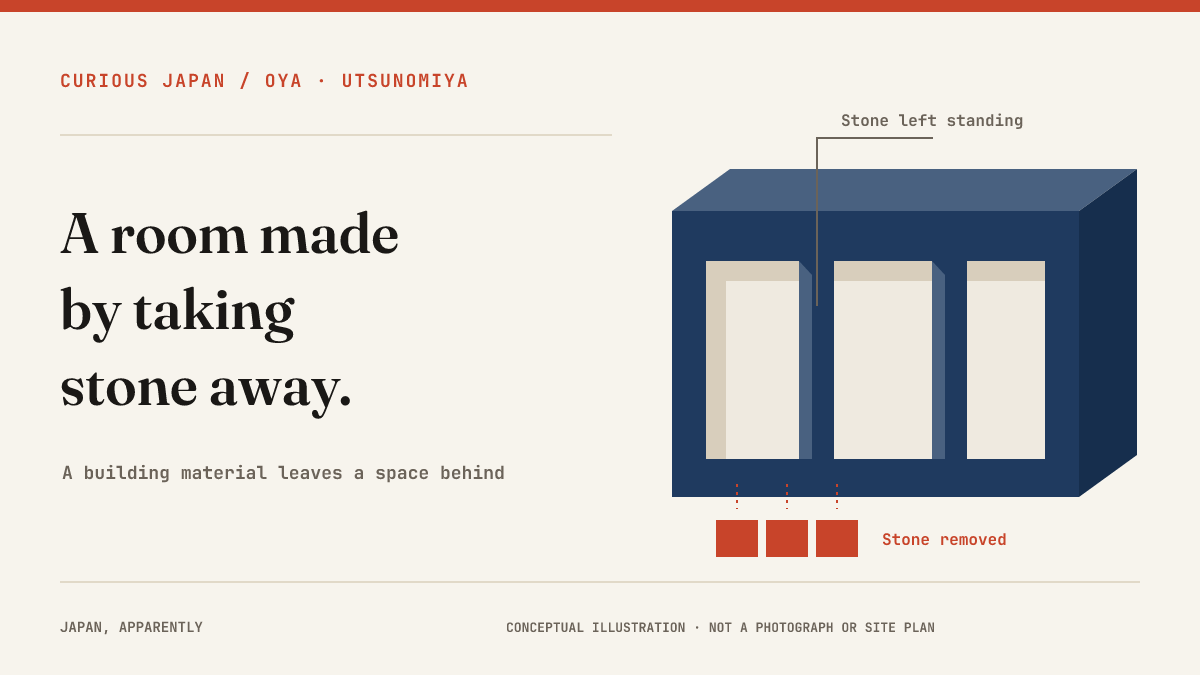
At Oya History Museum in Utsunomiya, Tochigi, you can descend into a former stone quarry covering about 20,000 square metres. The enormous room was made by removing building stone over decades. The museum records quarrying here from 1919 to 1986. The museum’s quarry history
The scale is striking, but the smaller details explain it: marks left by cutting tools, the equipment used to move heavy blocks, and the buildings those blocks became. Visiting is a way to follow a material from the ground into a city.
Research note: This guide uses museum, bus-operator and local-government information checked on October 10, 2026. We have not visited in person.
What made this underground space?
Oya stone is a type of volcanic tuff quarried around the Oya district. The museum’s geology and mining displays explain the material and the different ways of extracting it. Look at those displays before descending: they give the walls and columns a history beyond their appearance. Museum exhibits
The local Japan Heritage account explains that columns of stone were left to support the ceiling. The room and its supports belong to the same rock mass. Its walls preserve traces of the work that created the space. Oya stone heritage story
Oya stone was used far beyond the district, including Frank Lloyd Wright’s former Imperial Hotel in Tokyo. In Utsunomiya, stone walls and storehouses show how the material became part of ordinary surroundings. Older stone buildings have also been adapted as cafés and galleries. After visiting, look for the stone above ground too. Utsunomiya’s guide to Oya stone · Stone walls and storehouses · Present-day uses
Four thousand swings for one block
The museum gives a demanding measure of the hand-cutting era: a block measuring 18 × 30 × 90 centimetres is said to have required roughly 4,000 swings of a pickaxe. It dates the transition to mechanised cutting to around 1960. These are the museum’s historical estimates, rather than a calculation of every block in the quarry. Hand-quarrying exhibit
Moving the stone was another specialised job. The transport exhibit describes workers called kodashi carrying individual blocks weighing 150 kilograms on their backs with carrying frames. It also follows the later use of powered winches and changes in transport. The underground void is evidence of work done both to cut the stone and to get it out. Museum’s transport history
A quarry, a storehouse and a performance space
The museum’s timeline records wartime storage and factory use, followed by government rice storage in 1969. The museum opened to the public in 1979; concerts, exhibitions and film work subsequently brought different uses to the excavated space. Operator’s timeline
Some photographs show a dramatic church area. Utsunomiya’s tourism guide says this area is normally closed to general visitors and sometimes opens for a limited period. Do not plan an ordinary visit around access to that particular view without a current announcement. Official tourism guide
Admission, opening hours and reservations
The tourism bureau says ordinary visitors can buy admission at the window without a reservation. It suggests an hour or more for a leisurely visit. Allow additional time for travel and bus connections. Visitor guide
| Visitor | Published individual admission, checked October 10, 2026 |
|---|---|
| Adult | ¥1,000 |
| Elementary or junior-high-school student | ¥400 |
| Preschool child | Free |
Adult admission rose in April 2026. Payment is cash only. Operator’s current fees
| Season | Opening hours | Last admission |
|---|---|---|
| April–November | 09:00–17:00 | 16:30 |
| December–March | 09:30–16:30 | 16:00 |
The normal winter closure is Tuesday, moving to the following day when Tuesday is a public holiday. The operator also lists closure from December 26 to January 3, and warns of temporary closures. Check the museum’s homepage and announcements for your actual date.
A museum guide is a separate arrangement. An August 19 notice says its September and October 2026 in-house guide bookings are closed, while self-guided group visits are still being accepted. That announcement does not promise an English tour. Dated operator notice
Getting there without a car
From JR Utsunomiya Station’s west exit, bus stop 6, take a bus toward Oya / Tateiwa. Get off at Shiryokan Iriguchi (資料館入口) and walk about five minutes. The museum gives a bus journey of roughly 30 minutes; road conditions can change it. Museum’s published route
Check the return journey in the bus operator’s timetable search, as well as the museum’s closing time. The timetable for your travel date has not been checked for this guide.
If you also plan to visit Oya-ji Temple, compare the Oya sightseeing one-day ticket. It combines the specified Utsunomiya–Oya bus travel with museum and temple admission. Its adult price became ¥2,200 on April 1, 2026. Decide based on the stops you actually intend to make. Tourism bureau’s explanation · Bus operator’s 2026 price notice
The operator’s online-voucher instructions require an exchange at the Utsunomiya Station-front Commuter Pass Centre (宇都宮駅前定期券センター). A phone voucher is not simply a ticket to show when boarding; check the current exchange instructions and window hours before buying. Official exchange procedure
For driving, the museum advises searching its facility name or telephone number in navigation rather than only its street address, because its grounds cover a wide area. Operator’s navigation advice
Cold air, stairs and photography
The museum reports an annual average underground temperature of around 8°C. That is an average, not the temperature promised for your visit. Bring an extra layer even when it is warm outside, and wear shoes suitable for stairs. Museum’s temperature information · Tourism bureau’s visitor guide
Wheelchairs, strollers and walking carts cannot enter on the normal route. A paid golf-cart arrangement for walking difficulties needs advance telephone booking and is available only on eligible weekdays, subject to conditions. Operator’s access conditions
Photography sessions lasting two hours or more need permission, as does using tripods, monopods or selfie sticks. Keep stairs and narrow passages clear; do not fix cameras to floors or railings. Model-style, costume or prop shoots require approval and fees. Commercial footage use needs permission. Eating and drinking underground are prohibited. Full museum rules
For another enormous underground space with a different purpose, see G-Cans, Kasukabe’s flood-control facility. If the relationship between a structure and its practical job interests you, Osaka’s Gate Tower Building has an expressway ramp passing through it. More places are collected in Curious Japan.
Original editorial illustration: stone removed and columns left standing. It is a conceptual graphic, not a photograph, measured section or site plan of Oya History Museum.